4
Drivers tend to think of acceleration as the defining metric of automotive capability. Horsepower figures, torque curves, and zero-to-sixty times dominate showroom conversations, yet none of that performance matters without the ability to shed momentum with total predictability. When you press the center pedal, you are not simply slowing down four spinning tires; you are commanding a complex kinetic system that manages thousands of pounds of moving steel, transfers dynamic chassis weight, and dictates whether your vehicle remains pointed straight or spins out of control.
True vehicle control is an active dialogue between the driver’s input and mechanical execution. Braking is fundamentally an exercise in energy transformation, converting the immense kinetic energy of a moving vehicle into thermal energy through controlled friction. Every link in that operational chain—from the hydraulic master cylinder down to the microscopic surface of a brake pad—must perform flawlessly under extreme heat and pressure. Understanding how these individual components work together reveals why component health is the absolute cornerstone of roadway safety.
The Hydraulic Circuit: Multiplying Force Under Pressure
The braking process begins well before friction materials touch metal at the wheel hub. When a driver presses the brake pedal, mechanical leverage combines with the assistance of a vacuum booster or an electro-hydraulic actuator to multiply foot effort into thousands of pounds of clamping force.
This amplified mechanical force pushes a piston through the master cylinder, forcing non-compressible brake fluid through a closed network of steel lines and reinforced flexible hoses. The fluid acts as the nervous system of the braking assembly, transmitting pressure simultaneously to all four corners of the vehicle.
Because hydraulic pressure relies on the physical integrity of the fluid, fluid condition directly dictates pedal feel and braking response:
-
Moisture Contamination: Standard glycol-based brake fluids (DOT 3 and DOT 4) are naturally hygroscopic, meaning they absorb humidity from the surrounding atmosphere over time. As moisture content rises, the boiling point of the fluid drops drastically. Under hard downhill braking or emergency stops, water-contaminated fluid can boil, creating vapor pockets inside the lines. Because gas compresses while liquid does not, this vapor results in a soft, spongy pedal that sinks to the floor without slowing the car.
-
Hose Expansion and Degradation: Flexible rubber brake hoses near the steering knuckles flex with suspension travel. Over years of thermal cycling, internal rubber layers soften and expand outward under high pedal pressure rather than transferring that force to the calipers, causing vague modulation and delayed stopping times.
Flushing brake fluid at regular service intervals is not a cosmetic recommendation; it preserves the hydraulic density required to translate split-second driver reactions into immediate mechanical bite.
Friction at the Wheel: Calipers, Pads, and Rotors
At the end of each hydraulic line sits the workhorse of the system: the caliper and rotor assembly. This interface is where the physical conversion of kinetic energy into heat takes place, operating under temperatures that routinely exceed five hundred degrees Fahrenheit during normal city driving and double that under heavy loads.
The Clamping Action of the Caliper
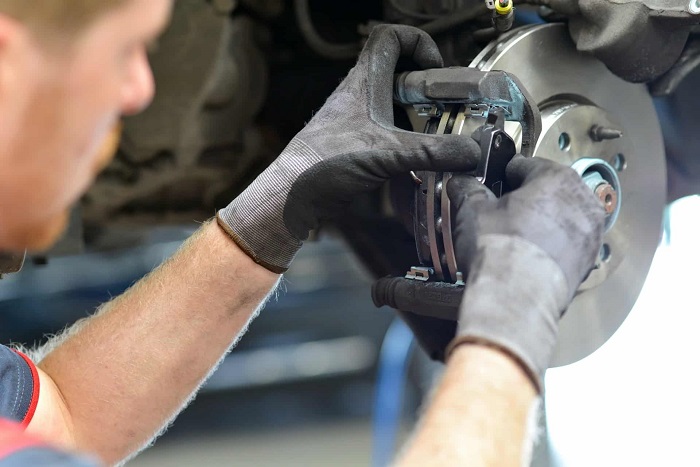
The caliper houses one or more pistons that respond directly to hydraulic pressure. When fluid enters the caliper bore, the piston moves outward, pressing the inner brake pad against the spinning brake rotor. In floating caliper systems, this movement creates a reactive pull that slides the entire caliper frame along greased guide pins, drawing the outer pad against the opposite face of the rotor.
If caliper slide pins lose lubrication or rubber dust boots tear, road salt and dirt cause the pins to seize. A stuck pin prevents the caliper from releasing fully, dragging the pad continuously against the rotor. This creates parasitic drag, which rapidly overheats the wheel assembly, destroys fuel efficiency, and glazes the friction surface until braking power drops off precipitously.
Friction Formulations: Semi-Metallic Versus Ceramic
Brake pads are engineered composites formulated to deliver consistent friction across wide temperature ranges without destroying the iron disc:
-
Semi-Metallic Formulations: Containing steel fibers, copper, and graphite, these pads offer exceptional thermal dissipation and aggressive initial bite. They perform reliably under heavy towing and aggressive driving, though they generate more black metallic dust and can accelerate rotor wear.
-
Ceramic Compounds: Composed of dense ceramic materials blended with copper and non-ferrous filaments, ceramic pads produce less noise and light-colored dust that does not stick aggressively to wheels. They deliver a smooth, progressive pedal feel that excels in everyday commuting, though they hold heat longer during sustained track or mountain descents.
Regardless of compound, a worn pad reduces the thermal barrier between the friction surface and the caliper piston. When friction material wears down past critical thickness, heat radiates directly into the caliper hydraulics, accelerating fluid breakdown and increasing stopping distances.
The Thermal Mass of the Brake Rotor
Brake rotors act as massive heat sinks. Modern ventilated rotors feature directional internal cooling vanes that pump ambient air outward as the wheel spins, shedding heat into the passing airstream.
When drivers experience a rhythmic pulsing or fluttering sensation through the brake pedal, they often assume the cast-iron rotor has physically warped into a wave shape. In reality, that pulsing is almost always caused by disc thickness variation (DTV). Uneven pad deposits bond to the rotor surface when hot pads sit clamped against a stationary rotor after a hard stop, or an improperly torqued wheel hub creates slight runout. Over thousands of miles, the rotor wears unevenly, creating high and low spots measured in thousandths of an inch that destabilize the vehicle during heavy deceleration.
Dynamic Weight Transfer and Directional Stability
Braking is not merely about stopping forward progress; it governs the dynamic balance of the entire chassis. When brakes are applied, vehicle weight transfers forward violently onto the front axle, compressing the front suspension struts and unloading the rear tires.
Because the front axle carries the majority of this dynamic weight—often handling sixty to seventy percent of total braking duty—front brake components are substantially larger than rear assemblies. However, the rear brakes play a crucial role in maintaining directional stability.
If the rear brakes engage too aggressively, the rear tires can break traction, causing the rear end of the car to kick sideways in a dangerous fishtail. If the rear brakes fail to engage sufficiently due to neglected maintenance, the front brakes must absorb excessive thermal energy, inducing severe nose-dive and front tire scrub that degrades steering authority. A properly balanced braking system keeps the chassis flat, stable, and ready to navigate emergency evasive maneuvers.
Modern Electronic Integration: The Digital-Mechanical Bridge
Modern automotive safety suites rely entirely on the mechanical competence of the braking system. Features like Anti-lock Braking Systems (ABS), Electronic Stability Control (ESC), and Autonomous Emergency Braking (AEB) do not operate independently of physical hardware; they act as digital controllers operating the existing mechanical valves.
When wheel speed sensors detect an impending wheel lockup on ice or wet asphalt, the ABS hydraulic control unit pulses pressure to that specific wheel up to twenty times per second. This prevents tire skidding, which allows the driver to maintain steering control while braking as hard as possible.
Similarly, stability control monitors steering wheel angle versus actual vehicle yaw, selectively applying individual brakes—such as the inside rear wheel during understeer—to physically rotate the vehicle back onto its intended path. However, if a caliper is seized, pads are glazed, or fluid contains air bubbles, the computer’s microsecond calculations cannot be executed at the road surface. High-tech safety algorithms are only as effective as the iron and rubber through which they exert physical force.
Maintaining the Operational Baseline
Brake degradation is rarely sudden; it is an insidious process that occurs over thousands of miles. Because the drop in performance is gradual, drivers frequently adjust their driving habits without realizing their vehicle’s safety margin has narrowed.
Reliable vehicle control requires proactive inspection rather than waiting for metal-on-metal screeching or a dashboard warning light. Inspecting pad thickness, evaluating rotor surface smoothness, ensuring caliper pins float freely, and flushing hydraulic fluid every two to three years maintains the mechanical baseline that safety engineers designed into the vehicle.
When you treat your braking system as an integrated control mechanism rather than an afterthought, you ensure that every emergency maneuver, highway stop, and steep mountain descent remains completely predictable, controlled, and safe.
